
Avoiding the Takaichi trap
Team Takaichi is right to go big, comprehensive and long duration; but wrong to fear markets and disrespect independent stewards of capital

Prime Minister Takaichi has started a revolution - or more precisely, a restoration - of Japan’s fiscal- and economic policy priorities. Her first-ever and just-out-last-week economic policy and budget strategy marks a previously unthinkable break with established fiscal governance. Out goes the incremental and “business as usual” conservative budget stewardship long safeguarded by the proud and powerful Ministry of Finance. In comes a full-on restoration of linking fiscal- to industrial policy.
Make no mistake: Takanomics is poised to be more inflationary than Abenomics; is destined to empower the BoJ to hike more aggressively; and, more fundamentally, Takaichi’s all-out push to restore METI’s industrial- and national economic security priorities over MoF’s fiscal prudence rhymes more with the “Fukoko Kyohei - Strong Country, Strong Army” philosophy embraced by the elites after the Meiji Restoration than with anything that guided Japan’s economic policy over the past 40 years. The “Takaichi Trap” is to underestimate her chances of success in re-building “Team Japan Inc” and to misread the implications for financial markets.

The key strategic realities of Takaichi’s economic policy speak for themselves:
* the size of resource mobilization:
Y370 trillion of public-private partnership investments is more than three-times bigger (in terms of GDP impact) than the industrial policy initiatives launched under Prime Minister Tanaka Kakuei’s 1972 “Remodeling of the Japanese Archipelago”. Tanaka’s plan came to less than 20% of starting point GDP; Takaichi’s plan is more than 60% of today’s GDP. Takaichi’s philosophy has always been “go big or go home…..”.
* the duration of public policy commitment:
Before Takaichi, there were basically only two areas in the national budget that had guaranteed funding committed for more than one-year - public education (three years) and national defense (five years). Everything else was subject to annual budget fights and lobbying-the-MoF to secure continued commitment; and if you could not secure continuation funding in the main budget, there was always a supplementary budget to re-insert your pet-projects onto the public funds ledger….. Rightly so, Takaichi wants to get away from Japan’s “budget adhocism” and replace it with strategic high-trust, long-duration funding via public-private partnerships: 17 focus sectors and 8 cross-sector target areas committed to from here to 2040.
* the focus on public- private partnership funding and “crowding in” of private risk capital:
Of the Y370 trillion, I expect approximately 10% to come from on-balance national government debt, 60% from private corporations, asset owners and investment managers, and 30% coordinated and syndicated by off balance sheet public policy financing firms like DBJ, JIC etc — basically the established-during-Meiji-but-privatized-by-PMKoizumi-in-the-early 2000s ex-FILP Fiscal Investment & Loan institutional stewards of off-balance sheet public finance (which used to be funded by the Postal Savings system, but now have to raise capital in public markets).
If I’m right and Takaichi can re-build “Team Japan Inc”, fears of unfunded government overspend are vastly exaggerated, while the realities of relentlessly building runaway inflation pressures are conveniently ignored. Caveat emptor…
And yes, the corporate governance focus is poised to shift dramatically, away from turning “lazy balance sheets” into higher dividends or share-buybacks towards raising debt- and equity capital to fund the private sectors’ contribution to the ambitious investment-for-growth push. Clear speak: Japan’s cost of capital is poised to rise, which in turn will speed-up industrial consolidation and corporate restructuring.
* the conviction that technocrats’ guidance and top-down industrial policy is essential to mobilize and guide Japan’s private sector flow of savings into investments:
Over the past 30 years, Japan’s industrial policy prioritized deregulation, privatization and financialization while fiscal policy prioritized tactical support packages for zombie companies, protection of vested-interest players from the disruption forced by deregulation and technological progress, as well as an ever-growing expenditure drain from rising entitlement claims in general, surging medical- and pension costs in particular.
Clear speak: over the past thirty years, the government “consumed” and supported the weak, while the strong and well capitalized part of the private sector was left to invest on its own terms. The result was an ever growing proportion of Japanese savings channeled into overseas rather than domestic investments: between 1995 and 2025, the share of total profits generated by listed companies from overseas sales surged from less than 20% to over 60% — a smart and rational rise in Japan’s return on investment engineered by strong company CEOs realizing that genuine “lazier faire” growth investment opportunities abroad were a better bet than the vested-interest entangled “lazier faire cosplay” offered in Japan. To wit: Japan’s two richest men made their fortunes from overseas investments, predominantly China and the US, rather than from their domestic production strategies — Fast Retailing’s Yanai-san and Softbank’s Son-san.
Team Takaichi is convinced this can and must be reversed by a re-focusing of CEOs minds towards Japan’s pre-1990s high-trust public-private partnership investment-for-growth model: Takanomics is a commitment to create domestic winners with a long-duration, domestic-focus industrial policy- and high-trust stable financing strategy. Takaichi’s goals are neither tactical, nor cyclical; they are structural, urgent, long-duration and openly nationalistic.
Importantly, the fact that there are 17 strategic areas does not indicate a lack of focus by Team Takaichi, but preents each and every company with an opportunity to join “Team Japan”. No Japan CEO -whether he/she leads an industrial, commercial, services, consumer, high-tech, low-tech, financial company in literally any sector- cannot find a future-growth-strategy possibility that aligns with his companies’ and Takaichi’s priorities. Something for everybody, no one excluded, no excuses, come join “Team Japan”.
In coming months, I shall not be surprised to see Team Takaichi starting to publicly shame CEOs who will not participate and commit to her new national agenda - just as the Japanese Stock Exchange started to threaten to shame CEOs who refuse to present concrete strategies to raise capital efficiency and raise shareholder value above at least 1-times book value (the “Yamaji Initiative” launched by then JPX Group CEO Yamaji in March 2023).
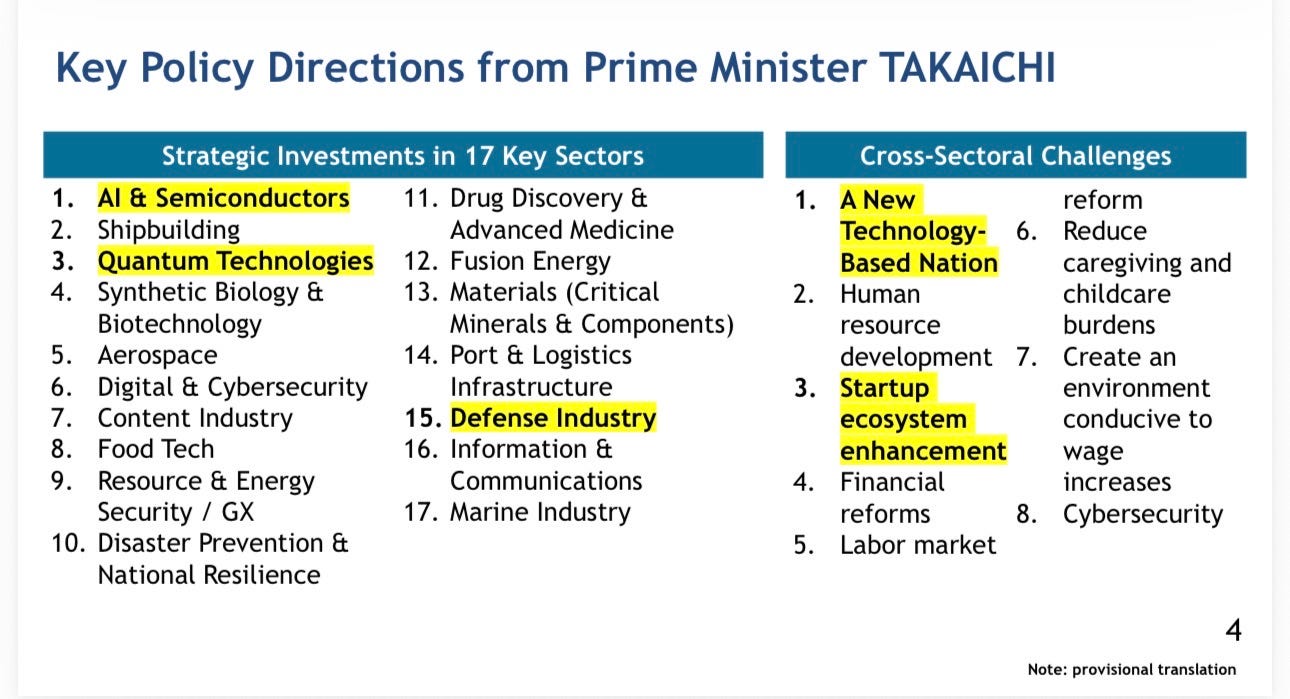
* a commitment to promote holistic- and balanced economic development, with a strong focus on human capital development, social resilience and regional diversification
Takaichi’s vision is not a winner-takes-all and socially divisive “tech-will-solve-all-our-problems” utopia, but clearly focused on creating a human-centric new economic structure. Her team is dead-set on wanting to avoid the extreme lop-sidedness of both US and Chinese recent growth dynamics: AI and AI infrastructure is an important part of Takanomics, but it is by no means the primary and only focus. Regional diversification and empowerment of local public policy decision makers is, for example, a core focus of the implementation strategy.
* and, last but not least, an (in my view very refreshing) cockiness…
…that Japan is not constrained by demographics, lack of natural resources or domestic capital, but instead perfectly capable of “pushing out her production possibility frontier”, of creating economic abundance, prosperity and yes, greater self-sufficiency.
In a remarkable shift in leadership style, Takaichi’s economic policy is not stuck in a vague and high-minded discussion group looking for a “New Capitalism” a-la PM Kishida — in fact she much prefers to decide and act over “let’s discuss and build consensus”. Her capitalism is ruthlessly focused on creating a united “Team Japan” where public- private partnerships inspire a new future-positive “can do” leadership mindset committed to forcing the next evolution of Japan’s economic-, industrial-, and social structure. To do so, Team Takaichi wants to restoring the kind of economic policy and governance that, well, produced the economic miracle in the 1960s, 70s and 1980s.
So far, so good.
What could go wrong?
Unlike Team Abe, Team Takaichi trusts elite technocrats more than she trusts entrepreneurs, risk takers and markets. Note that in the first annual top-bureaucrat promotion cycle under her watch, not a single senior elite technocrat promotion was vetoed by her Prime Minister Office. In contrast, Team Abe typically blocked about 20-30% of senior ministerial promotion proposals, replacing them with their own preferred candidates instead. (with one notable exception: there are credible suggestions that she threatened to replace the current MoF vice-Minister if MoF would try to sabotage her food consumption tax cut proposal…MoF caved, she got what she wanted, and MoF got everything else it wanted).
Meanwhile, there are indeed first concrete signs that the progress made over the past twenty years on incentivizing private entrepreneurship, best-in-class corporate governance & capital stewardship and independent fiduciary responsibility may have started to be reversed. This is where the real ideological clash between “Abenomics” and “Takanomics” comes through.
Specifically:
Despite paying lip-service to the importance of entrepreneurship, start-ups and venture capital, Takaichi’s tax reform council has presented a proposal to raise the “minimum tax” effective January 1, 2027. The draft bill is to halve the special deduction amount from Y330 million to Y165 million and raise the minimum tax rate from the current 22.5 to 30%.
Clear speak: the tax burden for successful founders and angel investors will surge. This obviously runs counter to the “we want Japanese unicorns and successful startups” mantra; and is most likely to force a new wave of “hollowing out” - ambitious founders setting up shop in Singapore or elsewhere where tax policy backs up a public policy commitment to entrepreneurship by creating tax incentivizes, not disincentives for successful entrepreneurs. It will be important to see whether this Takaichi council tax proposal will be overturned in this autumn’s concrete budget and tax plan. for 2027. For details, see here - JVCA report
The backlash against shareholder activism and private equity is perhaps most pronounced and concrete in the new METI draft proposals for the next round of corporate governance reform: company directors should now be empowered to reject takeover proposals on the basis of their own assessment of potential national economic security concerns. At face value, this would be giving an ultimate poison pill to directors. More importantly, it demonstrates a complete misinterpretation of what constitutes a directors fiduciary responsibility: a director must focus on acting in the best interest of minority- and other shareholders, and on who is the best owner and best enforcer of a corporate strategy designed to create wealth for all stakeholders. National economic security is NOT a directors responsibility.
Of course, a robust national economic security check is absolutely essential in the event of an ownership change; but that assessment is the responsibility of the government, not independent board directors. National economic security priorities may and will change over time - but that’s the domain of the nation’s policy stewards, not of a corporate board member. As I said, delegating that power to board directors is handing them a poison pill from heaven.
And then the big one:
Why does the MoF Minister question the best performing public pension manager in the world ?
Last week, Takaichi’s Finance Minister (who is also her most trusted adviser and confidante) openly urged the public pension GPIF to consider changing its asset allocation: “GPIF should buy more JGBs”.
This is a spectacular attack on all the pro-market and capital stewardship reforms promoted and enacted by Prime Minister Abe: before Abe, the GPIF was a fundamentally sleepy, dominated by Marxist economists asset allocation utility beholden to the MoF, the Keidanren (Japan’s big-business lobby), and the LDP. Backed by Abe’s leadership and personnel appointments, GPIF transformed to a best-in-class public fund manager. The whole point of Abe’s GPIF reform was to make independent the stewards of public pension assets from the whims and pressures of in-today, out-tomorrow political priorities. Here, Abe’s goal was for the GPIF to become the best-in-class role model for Japan’s private sector asset managers and stewards of capital.
And wow, has GPIF delivered as the institutions evolved over the past 15 years into arguably the best performing pubic fund manager in the world.
The numbers speak for themselves:
over the past 24 years, GPIF has significantly outperformed all global public pensions funds. In comparison to CALPERS, for example, GPIF has generated a surplus of 2.09% compared to a deficit of 3.73% generated by CALPERS. Impressively, GPIF has done so despite running more than three-times AUM, $1,600 billion vs $500 billion; and -remarkably- doing so with a team less than ten-times smaller, 187 GPIF professionals versus 2,843 at CALPERS. It pays less than 2 basis points (!) in fees, compared to CALPERS’s 49 bars points….
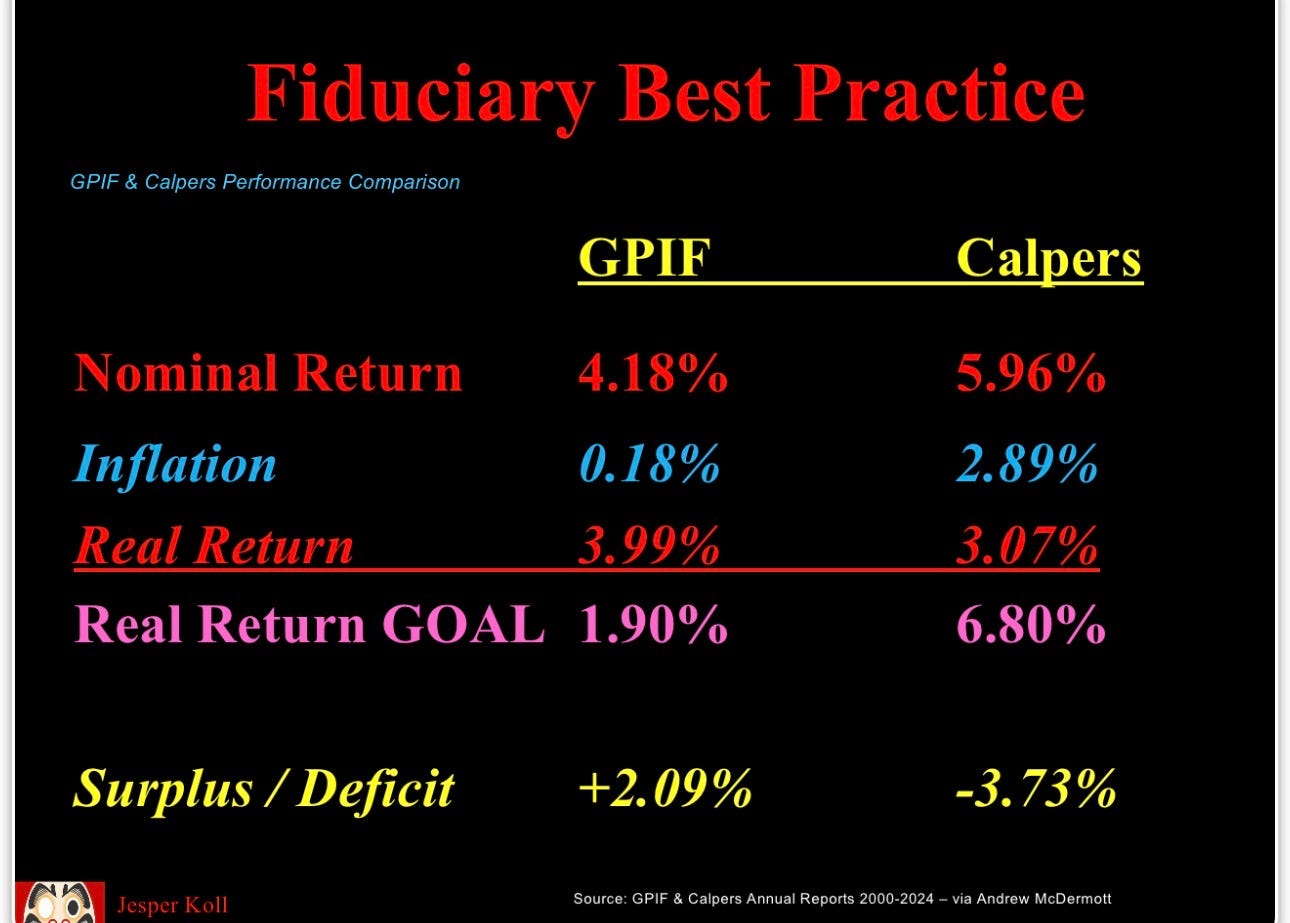
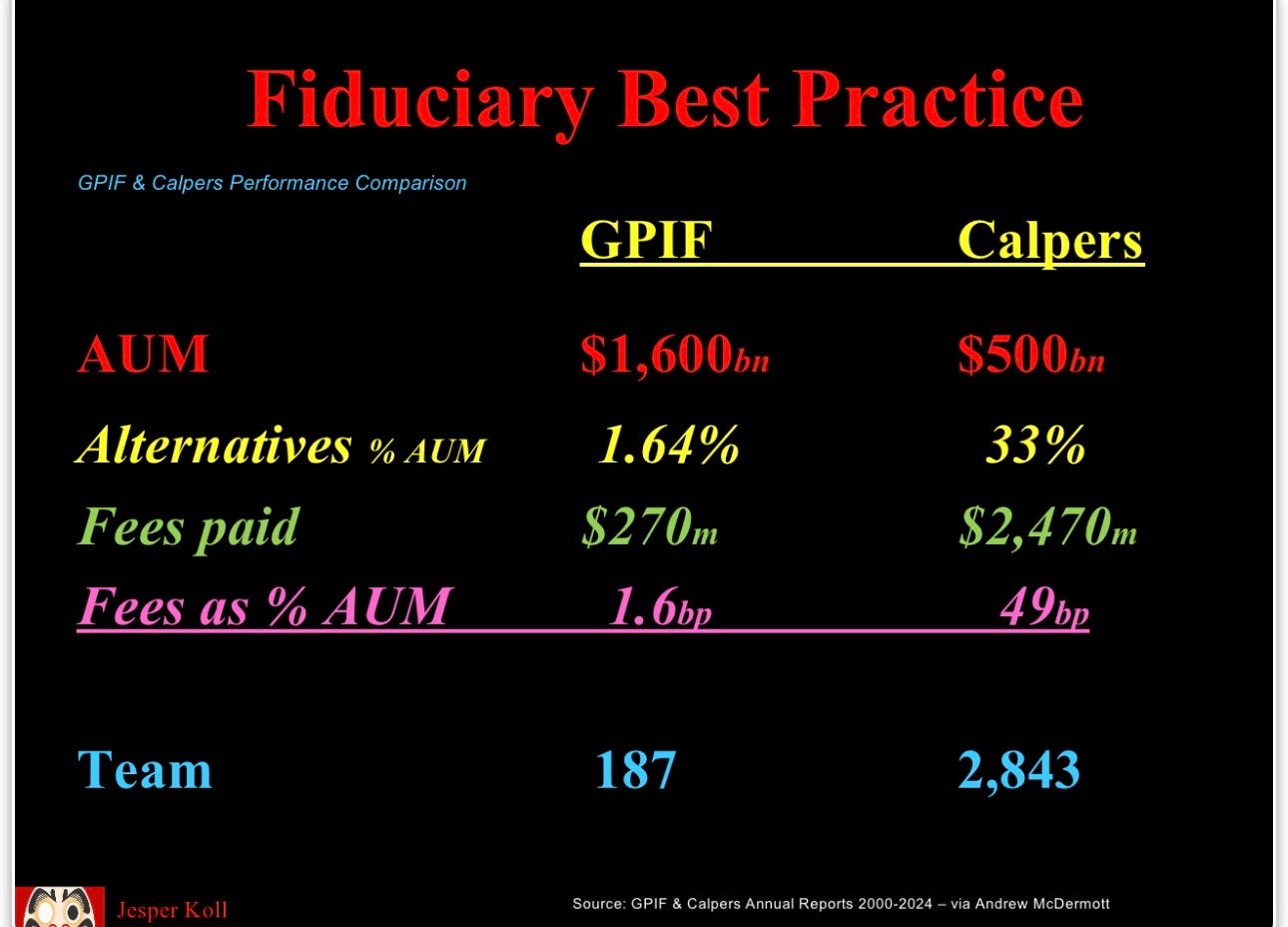
Clearly the GPIFs performance deserves a Nobel Prize for applied finance and capital stewardship.
Nothing succeeds like success….and success implies higher, not lower interest rates
By criticizing the GPIFs asset allocation, MoF Minister Katayama exposes the inherent discomfort financial markets have with Takaichi’s economic and fiscal policy. At best, Katayama exposes her own disbelief in the success of Takaichi’s policies; at worst, Katayama reveals a fundamental disrespect for independent capital stewardship, professional fiduciary responsibility and, well, capital markets:
bond yields are rising precisely because markets believe in the success of Takaichi’s pro-growth policies: as the potential growth rates rises, so does the absolute level of interest rates. To wit: A Japan with a potential growth rate of 1% and an inflation target of 2% has a “neutral” policy rate of around 2.5-3.5%. If the potential growth rate were 2% and the inflation target still 2%, neutral would be around 3.5-4.5%. This is per (an admittedly crude but fundamentally correct) Taylor rule calculation.
And yes, the corresponding 10-year JGB yield would be at least 175-225 basis-points above the neutral policy rate, ie just about double the current 2.9%. This is the reality stewards of capital are facing if indeed Takanomics’s “Japan is Back” in the growth game comes through. As such, it would be utterly irresponsible for the GPIF to overweight JGBs at current levels. Never mind that Minister Katayama also urged retail investors to to buy JGBs….
The only reason to go overweight JGBs is if you believe that Takaichi’s policies will fail to boost Japan’s potential growth and capital returns; that the Y370 trillion will create nothing but wasted excess capacity, falling enterprise values, and rising non-performing debt - ie produce the next deflationary cycle rather than an inflationary one. If indeed the growth potential falls, this will pull down bond yields.
Make no mistake: Minister Katayama’s call on the GPIF to buy more JGBs stands in direct contrast to PM Abe’s and BoJ Governor Kuroda’s call on the GPIF in 2023/14 to raise both non-Yen and domestic equity allocations and cut JGB exposure: at the time, trust in the success of Abenomics was the best aligned- and correct strategy to make money and raise the fund’s performance. Against this, Katayama today is effectively asking GPIF to not trust Team Takaichi’s growth strategy.
Avoiding the real Takaichi trap: not bond vigilantes but external directors focused on ROI
Importantly, MoF Minister Katayama’s pressure on the GPIF distracts from a very real trap Team Takaichi must work harder to avoid. The trap is not set by the “bond vigilantes” the MoF’s bursaries are worried about; it is set by the newly empowered, independent board directors and capital stewards now running corporate Japan: will they approve new growth investments primarily motivated by national industrial policy dictate now that, after hard-fought corporate governance reforms, they have been empowered and incentivized to only go for new investment projects that offer a higher-than-current ROI, return on investment?
Clear speak: Team Takaichi’s biggest challenge from here is to built trust and demonstrate, project by project, that her vision of a new industrial structure is indeed a structure likely to deliver higher returns than the one Japan currently has. I’m convinced she can deliver, but to do so Team Takaichi must be more upfront, professional and honest about the economic and capital market consequences of the strategy.
What about the BoJ?
To be sure, BoJ Governor Ueda holds key responsibility too. His reluctance, so far, to fully acknowledge the sustainability of the pro-growth and inflationary thrust unleashed by the rise in Japan’s corporate metabolism, has consistently delivered a further steepening of the yield curve after every singly rate increase. Yes, he is “behind the curve” and now that Takaichi’s fiscal- and industrial policy thrust is getting real, he’s poised fall even further behind. Unless, of course, he demonstrates trust in Takanomics and speeds-up the rate normalization process. Make no mistake: the longer he waits to raise rates now, the greater his signaling of distrust in the ability of Team Takaichi to deliver.
Governor Ueda knows better than anyone the reverse gravity axiom of financial economics: a higher growth potential forces higher, not lower interest rates. Interestingly, one of the BoJ board members have been encouraged to public float the idea of completing the “normalization” process in one full swoop, departing from the reluctant gradualism enacted until now. And he is right, in my view: now that the output gap is closed and that Japan is committed to an unprecedented public-private partnership for resource mobilization, why wait to get to neutral?
Takaichi should be urging Governor Ueda to hike rates because it would be the strongest initial vote of confidence in her Takanomics she can hope for. It would also, in my view, serve as a positive halo instilling confidence amongst private sector leaders that indeed Japan is back on track for sustainable growth and a coming up-shift in her potential growth rate.
Thank you for reading. As always, comments welcome….best & many cheers of hot & humid Shibuya-ku ;-j
Let me be the first to say thank you for this. Exciting times in Japan. Will be fascinating if Takaichi can overcome the oyaji inertia. I didn’t see much on energy policy. I think that is an enormous hindrance to any growth strategy in Japan.
Excellent insights as ever - thanks