
Takaichi-Bubble, Banzai...
Japan's next Prime Minister must create both an asset bubble and Yen appreciation to create a genuine feel-good factor for her people

Japan’s parliament will vote for a new Prime Minister when the next lower house session starts on October 15th. Most likely the new LDP President, Takaichi Sanae, will secure the necessary votes. She will have to lead Japan in a LDP-minority-led coalition. More importantly, she will be the first Prime Minister who faces a nation unsettled by the breakdown of two longstanding, trusted trends and essential underpinnings of Japan’s socio-political consensus:
the people are angry at inflation
the elites are angry at America
How Takaichi Sanae deals with these two issues will determine whether she’ll be a success or failure. The fact that - unlike her two technocrat-led-consensus-first-and-foremost predecessors - she’s been a fighter all her life makes me hopeful she’ll serve for more than just one three-year term. Like in “Shogun”, there’ll be plenty of drama, intrigue and unexpected plot twists: to succeed, Takaichi will have to create both an asset bubble and Yen appreciation.
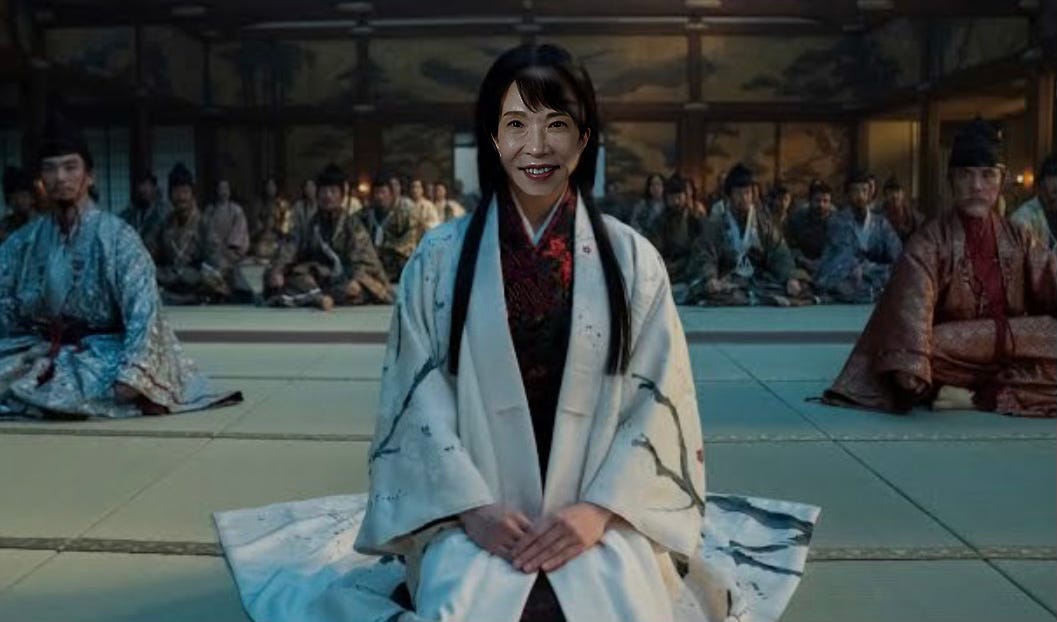
Curious, studious, and not afraid to have her own opinion
Before we explore the policy challenges and likely actions, let me offer some brief personal insights into Takaichi-sensei’s character.
Over the past thirty years I’ve had the fortune of being called upon for advise or discussion by many politicians, both LDP and other parties, as well as serving on various political study-groups. Of all the presentations made to politicians over these 30 years, Takaichi Sanae was one of exactly three politicians who, a day or two after the meeting, called or sent an e-mail asking specific follow-up questions. Both attention to detail as well as genuine curiosity and interest in exploring a different or novel point of view or analysis are, trust me, extremely rare features for a politician. (and no, she has had neither the time for nor a reason to want to flatter me…).
Takaichi Sane may be a lot of things, but she is serious, studious, open-minded, and not afraid to make up her own mind with fact-based arguments and analysis. It’s one reason, in my opinion, why both the elite technocrats and business leaders hold her in high regard.
Ditto for the LDP. Her opponent was young Koizumi who, yes, has a high-profile narrative of wanting to be a reformer; but who in reality does not have a single reform he can point to as something he actually got done while serving as State Minister (he served twice, under Abe for Environment and under Ishiba for Agriculture).
His father, Koizumi Junichiro, was absolutely a true champion of privatization of postal savings/insurance and enforcer of ruthless budget cuts for fat-cat public works- and general contractors, as well as Japan’s first national leader to push for ‘deep state’ governance reform. The son, Koizumi Shojiro, is excellent at maintaining the family legacy narrative of ‘aggressive reform’, but more than a little short on actually contributing in kind to the family legacy.
LDP pragmatism prevails
Clearly, LDP rank-and-file lost faith that his charm and skilled narrative will be enough to convince angry voters that the LDP can actually get things done. Instead, they chose to go with Takaichi who speaks in simple terms that, most importantly, don’t aim to drown the audience in cleaver sounding jargon, but instead catch attention by being genuine, simple, and obviously not dictated by the olde-boys-consensus (or the latest global political glib-speak).
In the public debates for this LDP Presidency everyone noticed the Takaichi smirk - when the other candidates spoke, her face clearly communicated ‘how often have we heard this before….’. Her frustration with the LDP old-guard is genuine, and is obviously well in tune with the current popular ‘Zeitgeist”. It was particularly in evidence when Koizumi told all-too-tired tales of how his government would encourage companies to raise wages….fresh wind & new ideas, seriously?
And yes, she herself paid for her tuition and cost of living while studying at Kobe University: she worked as a ‘companion’ - a kind-of modern-world Geisha, ie. someone who learns quickly that to get what you want you must be both charming and firm, and must never loose track of your goals and convictions. This woman knows more about how the world works and how to get what she wants than your average elite technocrat or business leader. She’s had to fight for every bit of her career. Here, her victory actually marks a welcome change to the entrenched “family business - inherited parliamentary seat” way of doing business for the LDP.
Her Japanese role model? Tokyo Governor Koike Yuriko.
Like Koike, Takaichi is a self-starter and always had to fight against a highly male dominated Japanese elite. Unlike Koike, who took the fall for Abe and resigned from being his Defense Minister after expositing a kick-back scandal, only to then build her own empire as Tokyo Governor and becoming, for many years, the most popular nationally recognized political leader (despite - or perhaps because - not being a member of parliament…), Takaichi stuck it out and kept on climbing within the LDP.
Her greatest success and reason for the LDP Presidency is not her endorsement by Abe Shinzo, but Aso Taro - arguably the most powerful politicians in Japan over the past thirty years.
Aso switched from supporting young Koizumi to Takaichi late in last year’s race, only to loose out last minute to compromise candidate (and consequent lame-duck PM) Ishiba. That was the first time in 30-years Aso had not brokered the winner, and he has been working overtime with Takaichi ever since that day to re-establish his rightful place in Japanese politics….it’ll be interesting to see whether Aso once again becomes Finance Minister or Deputy PM.
And yes, the fact she is a passionate and highly skilled heavy metal drummer tells you more about her character than any of those opposed to her views on constitutional reform or history textbooks could ever hope to convey. Her go-to song? ‘Burn’ by Deep Purple….read the lyrics, more on that below.
Enough of the gossip - lets focus on the two big challenges :
the people are angry at inflation - after thirty years of disinflation and de-facto stable incomes, the peoples’ purchasing power has been falling relentlessly for the past 36 months; and trust in policy makers’ ability to control or arrest this new trend is dropping fast: the Bank of Japan’s inflation target is 2% but despite measured inflation running above 2% for now 42 consecutive months, seven of the nine board members are still not convinced inflation is a problem.
Moreover, there have been more than five ‘extra budgets’ authorizing temporary price controls and/or income support measures to counter food- and energy cost increases. Yet inflation keeps on rising and real disposable incomes keep on falling.
Clear speak: Japanese policy is at a loss on how to contain or reduce inflation.
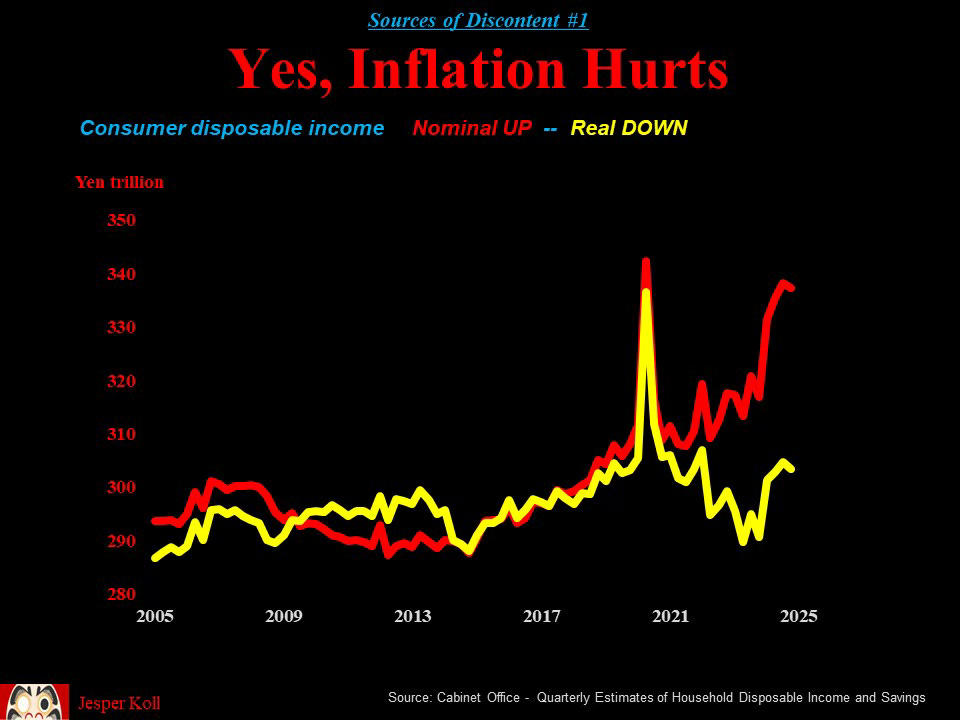
Opinion polls consistently confirm that inflation is by far the single most important issue the Japanese people want to get solved — typically 5-8 times more important than economic growth, or even social security; and typically 10-12 times more important than immigration….
How to not fight inflation
The standard narrative around Takaichi is she stands for all-out reflation. Much is made of her comment last year, attacking the Bank of Japan for raising rates. And she is openly advocating tax cuts and fiscal reflation at her best, all-out ‘modern monetary policy’ at her worst. This all worked and was the right policy when Abe became Prime Minister and Japan was on the brink of a deflationary spiral. But its clearly the wrong policy at the current juncture where an inflationary spiral is the greater risk: You don’t have to be an economist to understand that neither fiscal expansion nor monetary easing will bring down inflation - quite the opposite: Takaichi’s stated policies will only add fuel to Japan’s inflationary fire. In fact, Takaichi’s policies are an open commitment to create an asset bubble.
Clear speak: all else equal, Takaichi’s policies will make the people more angry at the LDP-policy-turbo-charger cutting the purchasing power of the people. She’d be unpopular and voted out by this time next year.
But not so fast. There are two ways to actually turn this turbo charger around and actually raise the peoples’ real purchasing power:
tax cuts or entitlement increases
Yen appreciation
The first is to re-direct fiscal expansion towards raising disposable incomes. This could be done by cutting consumption- or income taxes; or by raising entitlement payments, ie. more generous pension and/or social security handouts.
Working against the MoF…
The chart below shows that fiscal consolidation has had a very real negative impact for Japanese households: apart from the COVID crisis, aggregate payments from the Japanese government to the people have been flatlined to declining since the return of the LDP to power in late-2012 while payments from the people to the government have been on a steadfast uptrend: the current gap is just about 28% of household disposable income being paid to the government, while slightly less than 25% of disposable income are received from the government.
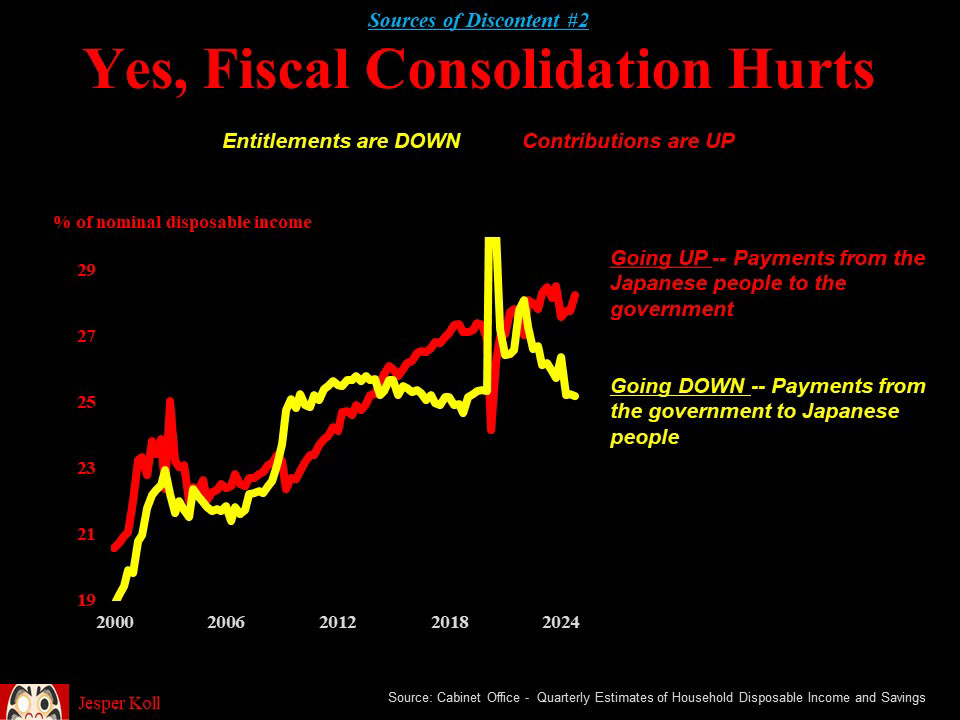
Importantly, since the return to power by the LDP in late-2012, in-payments have consistently been higher than entitlements received. And only during the brief years of Democratic Party rule — late 2009 to late 2012 — did the Japanese people benefit from receipts higher than payments.
Theoretically, Takaichi could change policy and close the gap between receipts and payments — even with inflation accelerating, fiscally funded boost of 3% to disposable incomes should be enough to create a feel-good factor, particularly amongst pensioners who make up as much as two-thirds of all people who actually vote.
So this is the standard populist option: you fuel inflation and fiscally bribe the people to a ‘feel good’.
Now, it is highly unlikely that Takaichi has the freedom to choose this option. Why? Because Japan’s elite technocrats rule: The Ministry of Finance would mobilize all of its formidable powers to kill such an initiative. Of course, there will be some modest cuts in minor taxes - the gasoline surcharge is under discussion; but a genuine reduction in the tax- or mandatory in-payments schedules is extremely unlikely, in my view. There is no “must dismantle the deep state” inclination in Takaichi’s convictions….
Working with the MoF
The second option is much more practical and realistic, albeit almost impossible to engineer without the help of the Americans - Yen appreciation.
Both the causation and correlations between the Yen and domestic inflation are empirically verified: for every Y10 of Yen depreciation sustained by more than 3 months, Japan’s CPI goes up by about 0.4%.
So, for example, the Yen going from Y110/$ in late 2021 to Y150/$ in late 2024 pushed up Japan’s consumer prices by approximately 1.6 percentage points (rising food & commodity prices added another percentage point).
So if Takaichi could get the Yen to strengthen back to Y110-120/$, Japan’s inflation would easily drop by at least 1-1.5% — enough to have positive real wage and income growth, which again should be significant boost to household “feel-good” (unless global food, energy and commodity prices surge to offset the gains in consumers terms-of-trade).
Importantly, the powerful Ministry of Finance should also be in favor of Yen appreciation as they seek, more than anything, a way to keep debt financing costs as low as possible. Clearly, a rise in the Yen should help reduce the growing market conviction that Japan is ‘behind the curve’ in her policies to contain inflation.
Clear speak: Yen appreciation is the fastest and most immediate way for Takaichi to have an early “win” and actually boost the purchasing power of the people.
How to get “good” Yen appreciation is the big question for Japan’s policy elite, still traumatized by “bad” Yen appreciation pushing Japan towards the brink of a death deflation spiral numerous times over the past thirty years. Can domestic demand be strong enough to withstand Yen appreciation?
Takaichi’s Japan Bubble 2.0
Of course, the primary example of “good” yen appreciation was during the asset bubble years of 1985-1990. This period, in my view, is the most comparable historic guide to what Prime Minister Takaichi is about to engineer:
Japan is ready to accept the U.S. demands for a weaker dollar as this now serves both the Prime Minister’s and the MoF’s primary objectives: create a feel good factor by bringing down inflation for Takaichi; and containing debt financing costs for the MoF.
Both Takaichi and MoF are prepared to engineer an asset bubble by :
1) ensuring the BoJ will keep real interest rates negative;
2) deregulating Japan’s asset management services industry and the corporate codes to speed-up industrial consolidation and the building of national champions
3) encouraging banks to take greater risks in general, increasing loans in particular. Here, public-private partnerships to build out domestic infrastructure- and capital intensive national industrial strategic assets will be promoted more aggressively, following the regional development success stories of both TSMC/Sony in Kyushu and Rapidus in Hokkaido.
Meanwhile, the risks of Yen appreciation forcing a rise in unemployment are, for all intends and purposes, minimal, given the wide-spread labor shortages across both the tradable goods- and the services sectors.
Of course, to get towards sustained Yen appreciation, Takaichi will need the help of the United States: U.S. interest rates must come down for the US dollar to depreciate.
It will be interesting to see whether, now that the U.S. President has made clear his intentions of forcing a regime change in U.S. monetary policy making, he and Takaichi will actually broker a “new deal” on U.S.-Japan interest rate policy during the Presidents first bi-lateral meeting in Tokyo later this months.
Which gets us to the second fundamental challenge:
the elites are angry at America - after more than seventy years of predictable and high-trust relations, the ambitious and aggressive “America first & foremost” agenda has not just dramatically increased economic costs for Japan. More importantly, the post-war national consensus trust in America as Japan’s benefactor, guardian, special partner and ultimate role model is quickly turning from disbelief-at-what-is-happening to mistrust and open discontent.
Instead of Mar a Lago, could we see a “Tokyo Accord” with Trump agreeing to help-out Japan’s new Prime Minister to achieve her number one policy goal — bring down inflation and raise the purchasing power of the people?
Personally, I don’t doubt such a deal is possible; but, given that there is nothing immediately transactional in it for the President, it would certainly be a huge test for Takaichi’s negotiation skills to get “Team Trump” to pull the trigger.
Specifically, threatening to demand a renegotiation of the recent unequal trade and investment deal may be enough to get a Japanese executive to cave in; but it almost certainly won’t convince President Trump that he better play nice. However, an increase in the Japan support budget for U.S. troops stationed in Japan might possibly do the trick.
Either way, I can only hope that a new and transparent Japan-U.S. currency accord can be a first concrete step to re-build trust in the mutually beneficial alliance.
More on this in a follow-on report. Thank you for reading and, as always, comments welcome. Many cheers from a still humid late-summer Tokyo ;-j
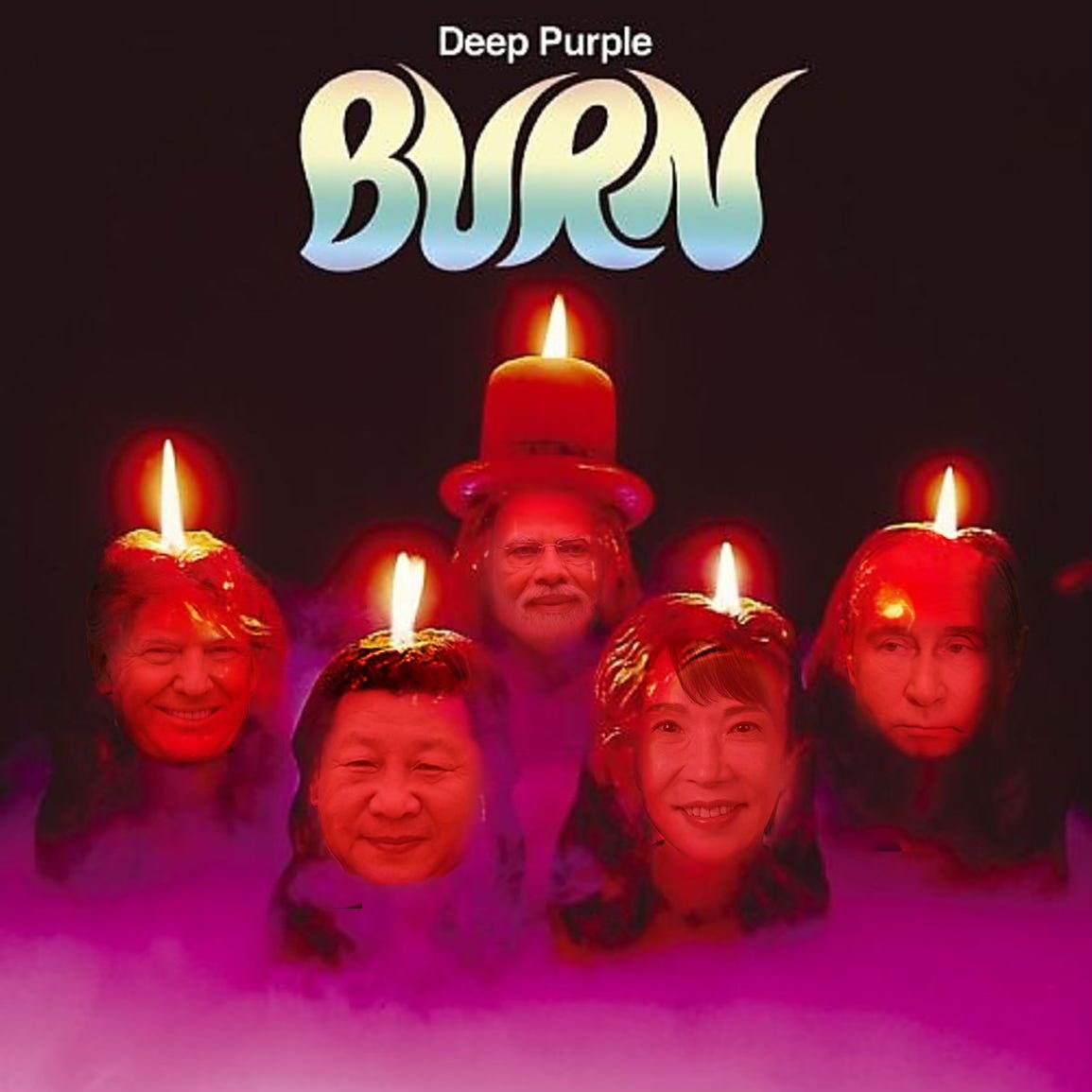
PS: yes, “Burn” by Deep Purple is her go to favorite song and album. She can run-through the drumming in a way that would leave Ian Paice smiling in admiration (Paice-san was Deep Purples’ speed-king drummer). But the real killer are the lyrics. Good thing Takaichi just plays the drums…..
The sky is red. I don’t understand
Past midnight I still see the land
People are saying the woman is damned
She makes your burn with the wave of her hand
The city’s ablaze, the town’s on fire
The woman’s flames are reaching higher
We were fools, we called her liar
All I hear is “Burn”
I didn’t believe she was devil’s sperm
She said “curse you all, you’ll never learn
when I leave there is no return”
The people laughed ‘till she said “burn”
Warning came, no one cared
Earth was shaking, we stood and stared
When it came no one was spared
Still I head “burn”
Songwriters : David Coverdale, Glenn William Hughes, Ian Anderson, Jon Lord, Ritchie Blackmore
The other thing Takaichi could do that would make a lot of people happy is to follow through on her campaign promise to rein in the subsidy program for mega solar projects. I’m cheering her on for that,
> all the presentations made to politicians over these 30 years, Takaichi Sanae was one of exactly three politicians who, a day or two after the meeting, called or sent an e-mail asking specific follow-up questions.
This was really interesting to me. Mind giving us a hint on who the other two politicians were?